Travel power · South Korea
South Korea Travel Adapter: What Plug Do You Need?
Short answer: South Korea uses type C and type F sockets — two round pins, the same geometry as Germany and France. Supply is 220 V at 60 Hz. Both socket shapes are in use, so which one your room has cannot be assumed. Whether your own device is fine depends on the INPUT line printed on it.
Country data verified 9 November 2026 · next review 9 May 2027
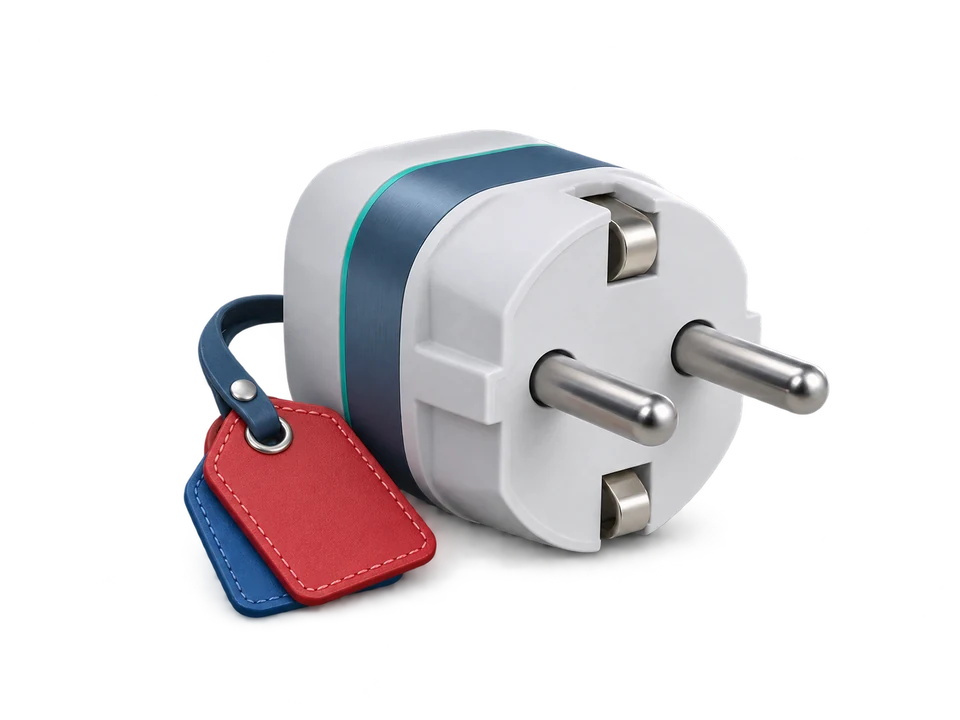
A plug adapter does not convert voltage. A single-voltage 120 V appliance plugged into a Korean 220 V socket through an adapter is still connected to 220 V. The adapter changes the shape of the connection, never the supply behind it.
South Korea at a glance
| Socket types | Type C (two round pins, 4 mm) and type F (two round pins with side earth clips, "Schuko"). Both are in use and both accept a type C plug; which one a given room has varies by building. |
|---|---|
| Nominal voltage | 220 V |
| Frequency | 60 Hz |
| Why the plug is not what you might expect | South Korea sits in the 220 V / 60 Hz combination, which is unusual: the frequency is the North American one, the voltage and pin shape are European. Travellers arriving from the United States often assume a flat-pin socket and are wrong; travellers from Europe often carry the right adapter already. |
| Earthing | Type F sockets are earthed through the metal side clips; a type C plug has no earth connection at all. Using a two-pin plug or a two-pin adapter on an earthed appliance removes its earth path rather than adapting it. |
| What you need if you are from North America | A plug adapter to type C or F, plus confirmation that your device's input range covers 220 V — usually stated as 100–240 V. A 120 V-only device needs more than an adapter. |
| What you need if you are from the UK or Ireland | A plug adapter from type G to type C or F. Voltage is compatible for devices rated 220–240 V, so no converter is required. Mind the earth: prefer an adapter that carries the earth through to a type F socket. |
Check the label, not the country
Almost every phone charger, laptop power supply and camera charger sold internationally is marked with a range such as INPUT: 100–240 V~ 50/60 Hz. That string means the device is built for both the 120 V and the 230 V worlds, and for both mains frequencies. On a range like that, South Korea needs only the pin shape.
If the label shows a single voltage, such as 120 V~ 60 Hz, the device is not intended for 220 V. Note that the frequency matches and the voltage does not — matching frequency is not a licence to plug in.
A nameplate, read in full
Take a phone charger printed INPUT: 100–240 V~ 50/60 Hz 0.5 A · OUTPUT: 5V≈3A / 9V≈3A / 15V≈3A / 20V≈3A 60W max. The input range covers 220 V at 60 Hz, so the only thing needed in South Korea is an adapter for the socket. The output half is a separate question about how fast a device can charge, which is what the charger wattage calculator covers.
Now take a hair dryer printed 120 V~ 60 Hz 1500 W. The frequency is right, the voltage is not, and nothing about that changes on arrival. It is not a job for a plug adapter, and a low-cost travel converter is not a substitute for checking the device — see adapter vs voltage converter.
Does the 60 Hz frequency matter?
For modern electronics: no, in practice. Chargers, laptop supplies, camera chargers and most small power supplies are switch-mode devices that convert the incoming supply internally, and they are marked 50/60 Hz precisely because the frequency is not part of how they work. The 60 Hz figure stops mattering the moment the label lists both.
Frequency does matter for a narrow class of devices that use the mains frequency as a timing reference or as the speed of a motor:
- Mains-synchronous clocks. A clock built for 50 Hz keeps time from the mains frequency; on 60 Hz it runs 20% fast. That is arithmetic, not a defect.
- Some motorised appliances — older turntables, simple fans, some hair dryers on their low setting — turn faster on 60 Hz than on 50 Hz. This is usually a nuisance rather than a fault.
- Anything with a heating element draws a slightly different power at a different voltage, and its rating is the only figure worth trusting.
What frequency does not do is rescue a device whose voltage range is wrong, and it does not create a compatibility problem for a device whose voltage range is right. For a phone or laptop charger, the voltage line is the one to read.
Earthing, and the adapter that quietly defeats it
Type F sockets are earthed by two metal clips on the side; type C plugs have no earth pin. A type C plug therefore fits a type F socket but leaves the earth connection unused. For a double-insulated phone charger that is normal and expected. For an appliance whose metal case is earthed, using a plug or a two-pin adapter that discards the earth removes a safety path that the manufacturer intended.
Practical consequence: if your device has an earth pin or earth clips, carry an adapter that keeps them. It costs no more and it is the only version worth packing.
Hair dryers, kettles and heaters
This site does not give a compatibility verdict for high-power heating appliances. Their current draw is in a different league from a phone charger, and both the adapter and the socket circuit become part of the question. Check the rating printed on the appliance and on the adapter, and prefer a dual-voltage model sold for travel. No automatic guarantee is offered here, and "the plug fits" is not one.
Two things travellers get wrong in South Korea
- Packing a US-style flat-pin adapter. The plug type is C/F, not A/B, despite the 60 Hz supply and despite the country's 110 V history. A flat-pin adapter will not fit.
- Assuming both socket shapes are interchangeable for earthed gear. A type C plug fits a type F socket, but it does not earth it. Bring the shape that matches what your device needs.
Charging several devices on the trip
One multi-port charger plus one socket adapter generally covers more devices than several single-port adapters, and it removes the need to find extra outlets in a hotel room. What each port delivers when several are in use is a charger question rather than a travel one: see laptop and phone on one charger. If you plan to charge away from the outlet, the power bank calculator applies unchanged in any country.
Sources
- IEC World Plugs — plug type, nominal voltage and frequency reference for South Korea (type C and F, 220 V, 60 Hz). Accessed 9 November 2026 and recorded in
data/countries.jsonas one of four sources. - Gangneung City tourism information — independently states 220 V / 60 Hz and describes the sockets as the same type used in Germany and France. Accessed 9 November 2026. A second independent source for the same three facts.
- National Law Information Centre — Electricity Business Act Enforcement Rule (Ministry of Trade, Industry and Energy Ordinance No. 606) — the regulator-level text behind the 220 V standard voltage and its ±22 V tolerance. Accessed 9 November 2026.
- [Annex 3] Standard voltage, standard frequency and tolerances (Article 18) — the annex states the standard frequency as 60 Hz with a tolerance of ±0.2 Hz, and the standard voltages as 110 / 220 / 380 V. Read as the annex PDF because the HTML annex page renders client-side. Accessed 9 November 2026.
- Manufacturer nameplate conventions (INPUT voltage and frequency ranges) as printed on the devices themselves — the reason the answer depends on your label rather than on the country alone.
Country-level data cannot establish what a particular wall socket in a particular building looks like. Where a check depends on your device, the answer depends on your label. Last reviewed 9 November 2026.
Related
- Travel adapter finder — run the full check with your own plug and label values.
- Italy travel adapters — type L, 230 V, and the same label-first method.
- Adapter vs voltage converter — what each one actually changes.
- USB-C charging cable guide — the part of the chain that is easiest to get wrong.